
15 min read
The Torah – a story containing laws
Ever crashed and burned in Leviticus? Here's the thing—the Torah was never meant to be read as a legal code. It's a story, and it's going somewhere.

How's your heart? How are you keeping your heart before God?
That's a strange way to start a talk about the law, I know. Totally different question. But we'll get there. This will get us there.
First, though, I want to swap a word. I'd rather say Torah than law. Torah is a Hebrew word, and it carries something the English word doesn't. It's not that "law" is completely wrong—there's an element of that in it. But Torah means teaching, instruction, guidance. It has the sense of a loving father embracing his children and pouring himself into them for their good. It's what loving parents do. And I think we lose all of that when we just say "law".
So how did we end up with "law"? It went Hebrew to Greek to English. When the Hebrew Scriptures were translated into Greek—the version they read in Jesus' day—torah became nomos. And when we translated nomos, we got "law". Complicated. Not particularly helpful.
Torah is also the name for the first five books of the Bible, the books of Moses. The big word for them is the Pentateuch, from the Greek for "five scrolls". And those five books tell one very particular story. So here's the line I want you to take home:
The Torah is a storybook containing laws, not a law book containing stories.
Why we crash and burn in Leviticus
Picture life in the ancient world, long before anything we'd recognise as a legal system. Say your neighbour gets out his chainsaw in the shed at ten o'clock every night. (I'm struggling for an illustration that works in ancient Mesopotamia. Stay with me.) What do you do? Call the cops? There are no police. Pull out the legal code Parliament passed and bash him over the head with it? There's no Parliament.
Law back then was a very different thing. Moses was writing to people who didn't have our modern idea of law at all. So to understand what he's doing, we need to put our modern ideas down and step into the story on Moses' terms.
And here's the thing: it really is a story. By the time you reach Exodus 19, where Sinai begins, you are sixty-eight chapters into the Bible and you haven't hit a single law yet. Sixty-eight chapters of narrative. Then the laws come, and they run, more or less, through to Numbers 10.
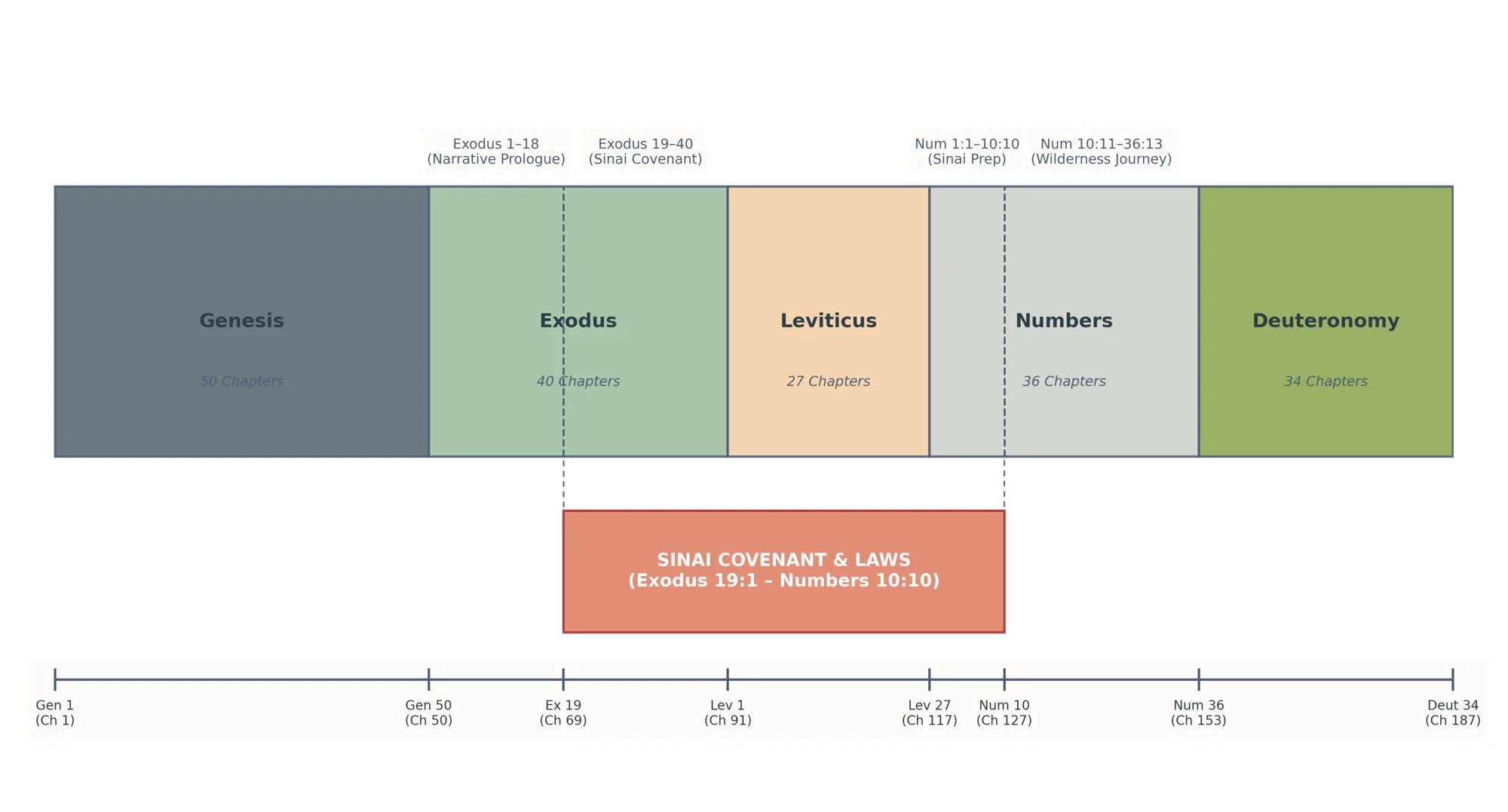
Moses could have opened Genesis 1:1 with the Ten Commandments. "Hey guys, this is God, you're Israel, you're not like the other nations, so here are the rules. Buckle up." He didn't. He told a story.
That's also why so many of us get the One Year Bible on 1 January, set off full of enthusiasm, and crash and burn somewhere around March in Leviticus and Numbers. Anybody? Right. You're not the only one.
And notice: the 613 commandments aren't written like a normal rule book. Plenty of them are incomplete—they leave gaps and don't cover the edge cases. The rabbis wrote the Talmud and the Midrash to fill them in. Why are there gaps? Because the laws serve the story. They were never meant to be the whole point.
Broadly, there are four kinds of laws: holiness (ritual symbols that set Israel apart), justice (how to put things right between people, with a dignity for slaves, women, foreigners and even animals that stands out against the nations around them), sacrifice, and sacred time (the feasts and festivals). And they did real work. They revealed God's holiness, set Israel apart as a witness to the nations, exposed the sinfulness of the human heart, offered forgiveness through faith, gave Israel a way to worship, and gave God's direction for health. And above all, they pointed to and prepared the way for the Messiah.
What they never were was your ticket to righteousness. The Torah isn't a dry legal code for justifying yourself by external performance. It's one long story that leads us through the broken law and beyond it, straight to Jesus.
One rule, and he couldn't keep it
So let's look at how the story starts.
It starts with the creation mandate: "Be fruitful and increase in number; fill the earth and subdue it" (Genesis 1:28 NIV). Humans were made to rule with God. It's a glorious picture: set in the highest possible place, alongside God, sharing his glory and his work.
And Adam gets… juuuuust one thing. "Stay the heck away from that one single tree!" Or as we'd say now, Adam, you had one job. There are 613 commands in the Old Testament, but just one for you, and you couldn't do it.
Did you notice that? Moses starts his story with one rule, and the man can't keep it. What do you think he's trying to tell us from the get-go?
Look at the parallel he builds. Adam is placed in Eden, a garden sanctuary, a template of heaven landed on earth. He's given one command. He's tempted by the serpent, he disobeys, he's cursed, and he's exiled east. Israel is placed in the Promised Land, a new Eden. It's given 613 commands—just a few more. It's tempted by the Canaanites, disobeys, is cursed, and is exiled east to Babylon.
The story starts with failure and ends with certain failure. Right at the end of Deuteronomy, Moses prophesies that Israel is going to blow it:
They will turn to other gods and worship them, they will reject me and break my covenant. And when many disasters and calamities come on them, this song will testify against them.
—Deuteronomy 31:20–21 NIV
That's how Moses ends his magnum opus. Even Moses himself doesn't get into the land, because he "did not trust in me enough" (Numbers 20:12 NIV). Adam's heart and Israel's heart weren't right, and under that arrangement they couldn't be.
And yet, as early as Genesis 3, God is already preaching the good news. Speaking to the serpent, he says:
And I will put enmity between you and the woman, and between your offspring and hers; he will crush your head, and you will strike his heel.
—Genesis 3:15 NIV
The theologians call it the protoevangelium, the first gospel. Three chapters into the Bible, and the offspring—the seed, singular—is already promised. God's plan is a person. The perfect Adam that Adam couldn't be. The perfect Israel that Israel couldn't be. The perfect you that you couldn't be. He's in Jesus, and we're told so straight up.
Then comes Abram:
Abram believed the Lord, and he credited it to him as righteousness.
—Genesis 15:6 NIV
What a massive hint about what pleases the heart of God. Faith. Later God says Abraham "obeyed me and did everything I required of him, keeping my commands, my decrees and my instructions" (Genesis 26:5 NIV). The astute among you will say, "Hang on, there weren't any commands and decrees yet!" Exactly. God spoke to Abraham personally, and Abraham said, "Yes, Lord," and followed through. He trusted and obeyed. Abraham kept his heart right.
So how's your heart? Where is your good heart coming from? Is it I trust you, Jesus, I know your goodness? Or is it the treadmill—do all the right things, do all the right things, surely this is how it works? It isn't how it works.
Paul puts it simply: "Why, then, was the law given at all? It was added because of transgressions until the Seed to whom the promise referred had come" (Galatians 3:19 NIV). Look at how the story actually unfolds. Moses goes up the mountain and gets some laws. He comes down, and there's more sin. Back up the mountain for more laws. After the people refuse to enter the land in Numbers 13 and 14, God adds tassels in Numbers 15, so they'll look at them and remember his commands. Tassels. We'll do tassels. But it's not ultimately going to work.
Here's something juicy. Scattered through the five books is a little Hebrew phrase, usually translated "in days to come", which straightforwardly means in the last days. It turns up in the prophetic poems spliced into the narrative. Jacob gathers his sons to tell them what will happen "in days to come", and says the sceptre will not depart from Judah (Genesis 49). Balaam, hired to curse Israel, can't stop blessing it and sees that "a star will come out of Jacob; a scepter will rise out of Israel" (Numbers 24:17 NIV). And Moses warns of disaster "in days to come" (Deuteronomy 31:29 NIV). Little hints, again and again, looking far ahead to what Jesus will do.
So what's the punchline of the Torah? Not obey the law and God will love you. It's we know that won't work, so look at Abraham. He came before the law, and he kept his heart right because he trusted God.
The photocopy and the original
Jesus didn't come to tear any of this up. "Do not think that I have come to abolish the Law or the Prophets; I have not come to abolish them but to fulfill them" (Matthew 5:17 NIV). Then he sets the bar terrifyingly high: unless your righteousness surpasses that of the Pharisees, you will certainly not enter the kingdom of heaven. His first hearers must have thought, Well, that's heavy. But what he's really saying is, I'm going to give you a new heart. I'm going to put my righteousness in your heart. So Paul can say that "Christ is the culmination of the law so that there may be righteousness for everyone who believes" (Romans 10:4 NIV).
There's one more thing I really want you to catch. When God gives the instructions for the tabernacle, he keeps saying the same thing: "Make this tabernacle and all its furnishings exactly like the pattern I will show you" (Exodus 25:9 NIV). The altar, the lampstand—everything "just as you were shown on the mountain". Moses is copying a design that comes from somewhere else.
The writer of Hebrews, who was so soaked in the Old Testament he'd just about memorised it, saw what that meant. The priests "serve at a sanctuary that is a copy and shadow of what is in heaven" (Hebrews 8:5 NIV). Just as Eden was a copy of heaven, the tabernacle was a copy too—a photocopy, a facsimile of something pure and authentic in heaven.
The law is only a shadow of the good things that are coming—not the realities themselves.
—Hebrews 10:1 NIV
Shadows can look amazing. Have you ever seen one of those aerial photos of camels in the desert at sunset? The shadows are stunning, but they're not the camels.
Anybody built a house? Imagine you move in, invite people round, sit them down, and spend two hours poring over the plans. "Look at this foyer. Isn't it beautiful?" And they're staring at you, thinking, We're sitting in it! Is that silly or is that silly? Once the house is built, you file the plans. You might not look at them again for years, because you have the house.
Who gets married and then lives as if they're still engaged? Or picture a newborn: "Welcome to earth, little one." "Actually, I'd like to go back in, if you don't mind." No, no. This is better. And the longer you're out, the more obvious it is that you're not going back in.
Do you know why we don't follow the 613 commands? Because we've dispensed with the photocopy. We have the heavenly original. The Holy Spirit is the deposit guaranteeing our inheritance, and that means what's living in you right now is heaven. It's God himself. Jesus has burnt the photocopy. You get the real deal. You can keep your heart right because God lives in you.
That's why Paul gets so worked up in Galatians. If they think circumcision will do it, he says, they may as well go the whole way (Galatians 5:12). All the blokes cross their legs. It's ridiculous, and Paul knows it's ridiculous.
Paul gives the law other jobs as well. It was a guardian, a tutor: "the law was our guardian until Christ came that we might be justified by faith" (Galatians 3:24 NIV). Who wants to stay a child under supervision forever? And it was a prosecuting attorney. When behaviour goes downhill, the rules go uphill. Remember when the zero-tolerance signs went up in every shop after 2020? Those signs showed up because people were behaving badly. Or think of a parent: "No, darling, we don't do that." Darling didn't know until you said so, but now darling's on the hook.
I'm not here to trash the law. It was exactly what it needed to be, at the time it was given. It's still good theology. It wasn't written to us, but it was written for us, and it tells us who God is. "All Scripture is God-breathed and is useful for teaching, rebuking, correcting and training in righteousness" (2 Timothy 3:16 NIV). Paul didn't have the New Testament when he wrote that. He meant this. It's wisdom, too: Psalm 119 delights in it, Israel's obedience was meant to show its wisdom to the nations (Deuteronomy 4:6), and Paul takes "do not muzzle an ox" and wisely applies it to paying gospel workers (1 Corinthians 9:9).
And my favourite: the law shows love. Jesus said all the Law and the Prophets hang on two commands—love God with everything, and love your neighbour as yourself. All 613 commands, boiled down and distilled into love. Not the "you be you" kind of love that doesn't mean anything, but love rooted in the character and nature of God. "Whoever loves others has fulfilled the law" (Romans 13:8 NIV). And who fulfilled it first, and how? Jesus did, with the ultimate expression of love.
Faith expressing itself through love
So, some quick questions.
Do Christians have to obey the Old Testament law? No. Good, that was easy.
Are the Ten Commandments still binding? Yes and no. They're consistent with the law of love, so a life led by the Spirit will start to look like them. But you don't get to heaven by keeping them. That's a big difference.
What about pork, shellfish and the Sabbath? Short answer: no. If you want to keep a Sabbath for the wisdom of it, go for it—it's incredibly smart. But not to get your heart right with God.
Was anyone ever saved by keeping the law? No. It couldn't, and it didn't.
Read Hebrews 10 when you get the chance. But spend a few minutes in Galatians 5 with me. Paul is writing to people under massive pressure to come back under the law, to be circumcised and keep the festivals, or else they won't be right with God.
It is for freedom that Christ has set us free. Stand firm, then, and do not let yourselves be burdened again by a yoke of slavery.
—Galatians 5:1 NIV
Don't do it! It's as daft as admiring the plans instead of enjoying the house. And it's serious: "You who are trying to be justified by the law have been alienated from Christ; you have fallen away from grace" (Galatians 5:4 NIV). Heavens above.
Then comes the line I'd love you to say out loud:
The only thing that counts is faith expressing itself through love.
—Galatians 5:6 NIV
The only thing that counts is faith expressing itself through love. That's the punchline. "The entire law is fulfilled in keeping this one command: 'Love your neighbor as yourself'" (Galatians 5:14 NIV). And "if you are led by the Spirit, you are not under the law" (Galatians 5:18 NIV).
So you have a choice. You can get really excited about the photocopy, or you can have the original. You can get excited about a tent in the desert, or you can have heaven.
How do you keep your heart right with God? You receive, by his grace, his presence in you. He changes your heart. He writes all that was real about the law onto your heart. He makes you a new person and lives in you. And every requirement of the law, and then some, is fully met in you, because Jesus died for you. That's it.
Now, nobody's ramming circumcision or festivals down our throats. But there are subtler ways to slip back into thinking we're saved by our performance. Ask plenty of people whether they're a Christian, and you'll hear, "Oh yeah, I try to be a good person." That's the photocopy. That's the earthly tabernacle, not heaven.
So can we be done with performance? Can we be done with trying to earn what God has already given us, freely and fully, in himself?
It is for freedom that Christ has set you free. Someone who lives in the love of God, who has received his forgiveness, who has settled the score on the things they regret and the things that are broken, and who has a clean heart and keeps a clean heart—that person is free. If that's not you yet, it can be. Don't settle for the photocopy. Take the real, heavenly deal.
So, one last time: how's your heart?


